India offers international buyers an enormous supplier base across agriculture, food products, textiles, pharmaceuticals, engineering goods, chemicals, consumer products and many other categories.
But a supplier appearing on a marketplace, responding quickly to WhatsApp messages, or offering an attractive price does not automatically make them the right supplier for an international order.
For an overseas buyer, the more important question is:
Can this supplier reliably deliver the product, quality, documentation and commercial terms that my business requires?
That is why supplier verification should happen before price becomes the deciding factor.
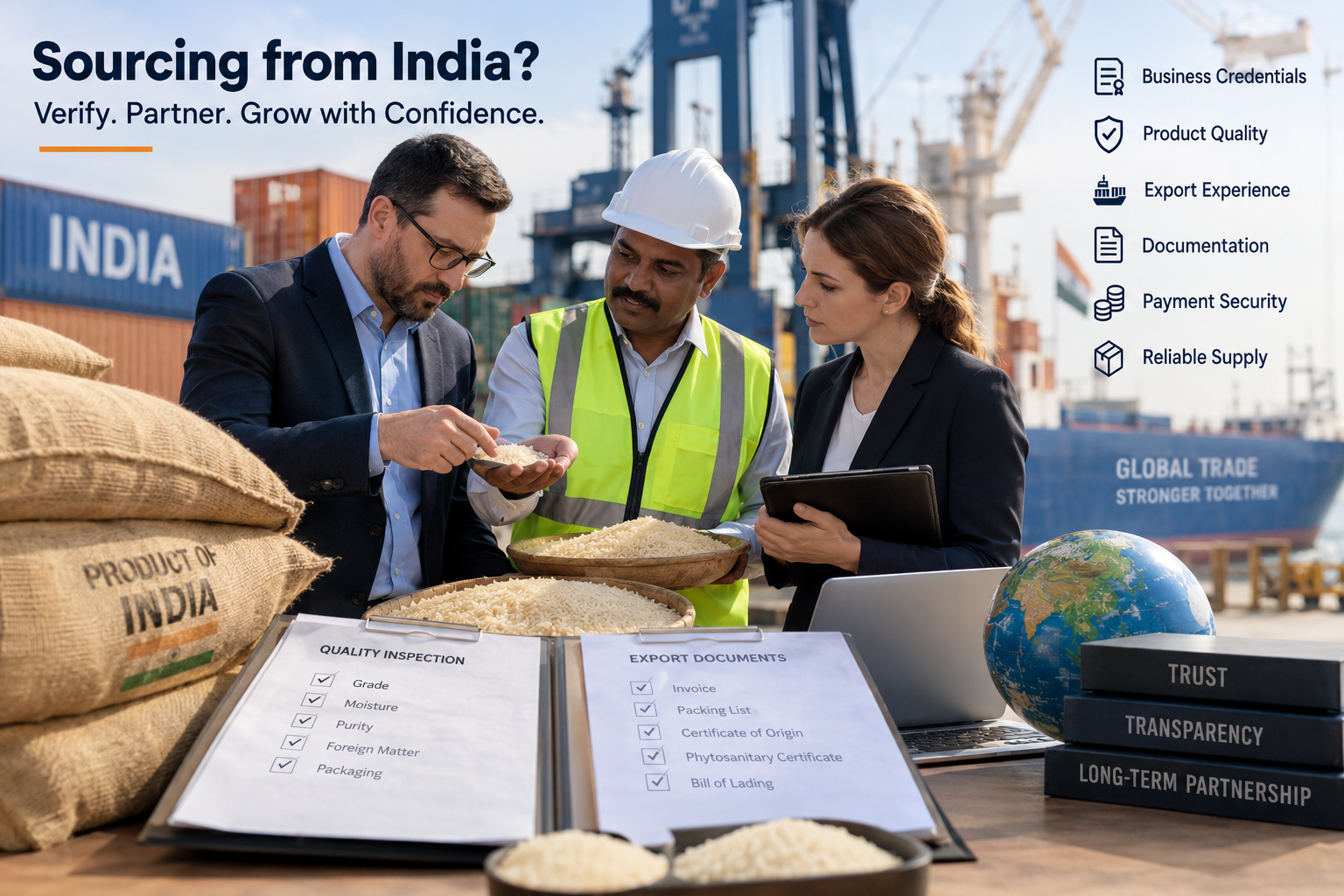
Whether you are sourcing rice, spices, agricultural commodities, textiles, manufactured goods or other products from India, here are the key areas international buyers should verify before selecting an Indian supplier.
1. Verify the Supplier's Legal Business Identity
Start with the basics.
Before discussing large quantities or making any payment, an international buyer should establish exactly who they are dealing with.
Ask for and verify relevant business information such as:
• Legal business name
• Registered business address
• Company registration details
• GST registration, where applicable
• Import Export Code (IEC)
• Relevant industry registrations or licences
• Official company email and contact details
• Bank account details in the legal business name
• Names and designations of the people authorised to conduct the transaction
The objective is not simply to collect documents.
The objective is to establish that the company you are negotiating with, the company issuing your commercial documents and the company receiving your payment are properly connected.
A mismatch between these details should never be ignored.
2. Verify Whether the Supplier Actually Exports
A company may be perfectly legitimate and still not be the right supplier for an international buyer.
There is an important difference between:
selling domestically in India and consistently executing international shipments.
Ask questions such as:
• Which countries have you exported to?
• How long have you been exporting?
• What products have you exported?
• What shipment volumes do you normally handle?
• Which ports do you commonly use?
• Can you provide evidence of previous export activity?
• Are you familiar with the documentation required for the destination country?
A supplier's ability to manufacture or procure a product is only one part of the equation.
International trade also requires competence in documentation, packaging, logistics, customs procedures and communication.
3. Verify the Actual Product — Not Just the Quotation
One of the most common mistakes buyers make is comparing suppliers based primarily on price.
A quotation saying:
Product X — USD 000/MT
does not tell you enough.
Before comparing prices, make sure you are comparing the same specification.
Depending on the product, verify:
• Grade
• Quality parameters
• Origin
• Size or specifications
• Composition
• Moisture
• Purity
• Packaging
• Labelling
• Shelf life
• Certifications
• Permitted tolerances
• Inspection requirements
For agricultural and food products in particular, apparently small differences in specification can have a significant impact on the commercial value of the shipment.
The cheapest quotation is not necessarily the cheapest shipment.
A lower price that results in rejected goods, quality disputes, delays or additional costs can ultimately become much more expensive.
4. Ask How Quality Is Controlled
A serious supplier should be able to explain how quality is maintained, not simply promise that the product is “best quality.”
Ask:
• Where does the product come from?
• Who performs quality checks?
• Is there an internal QC process?
• Are laboratory tests conducted where required?
• Can samples be provided?
• Can third-party inspection be arranged?
• What happens if the shipment does not meet the agreed specification?
For larger or recurring transactions, buyers should consider documenting the agreed specifications clearly in the commercial contract.
The more precisely quality is defined before shipment, the less room there is for disagreement afterwards.
5. Verify Documentation Capability
International trade is documentation-heavy.
Depending on the product and destination, an export transaction may involve commercial invoices, packing lists, certificates of origin, inspection or health certificates, phytosanitary documentation, shipping documents and other regulatory paperwork.
The exact requirements vary by product and destination country.
A buyer should therefore ask:
“Can this supplier provide the documents my country requires for this particular product?”
This question should be answered before the order is finalised, rather than after the cargo is already on its way.
Documentation is not an administrative detail.
For an international buyer, incorrect or incomplete documentation can result in:
• Customs delays
• Additional costs
• Clearance problems
• Regulatory issues
• Shipment delays
• In some cases, rejection of the cargo
6. Verify the Commercial Terms in Detail
Never evaluate a supplier based on the headline price alone.
Clarify exactly what the quoted price includes.
For example:
• EXW
• FOB
• CFR
• CIF
• Other agreed Incoterms®
• Packaging
• Inland transportation
• Port charges
• Documentation
• Inspection
• Insurance, where applicable
• Freight, where applicable
Also establish:
• Minimum order quantity
• Production or procurement lead time
• Payment terms
• Shipment schedule
• Validity of quotation
• Currency
• Loading port
• Expected transit arrangements
Two suppliers offering apparently similar prices may actually be offering very different commercial packages.
7. Verify the Payment Details Carefully
Payment fraud is one of the risks international buyers should take particularly seriously.
Before making a payment, independently verify:
• Beneficiary name
• Bank name
• Account details
• Business address
• Whether the bank account is held in the supplier's legal business name
• Whether any last-minute changes to banking details have occurred
Be particularly cautious when payment instructions suddenly change during an ongoing transaction.
A request to send money to an unrelated personal account, a third-party company or an account in a different name should trigger additional verification.
Never let urgency replace due diligence.
8. Verify the Supplier's Communication and Responsiveness
This sounds simple, but it is one of the most useful practical tests.
Pay attention to how a potential supplier communicates before you place an order.
Do they:
• Answer questions directly?
• Provide documents when requested?
• Understand your specifications?
• Give consistent information?
• Communicate clearly about timelines?
• Disclose limitations honestly?
• Follow up when they say they will?
A supplier who is difficult to communicate with before receiving an order may become considerably more difficult to manage once your money and shipment are involved.
Good international trade requires more than a good product.
It requires reliable communication.
9. Verify Production or Supply Capacity
A supplier may be genuine but still be unable to fulfil your required quantity consistently.
This becomes especially important when buyers are looking for:
• Container-scale shipments
• Large commodity volumes
• Recurring monthly supplies
• Seasonal products
• Private-label production
• Custom specifications
Ask how the supplier plans to fulfil the order.
Is the product:
• Manufactured in-house?
• Procured from another producer?
• Aggregated from multiple sources?
• Available only seasonally?
• Dependent on a particular production region?
Understanding the supply chain behind your supplier can help you assess whether the relationship is suitable for one shipment or long-term business.
10. Check Whether the Supplier Understands Your Market
A good Indian supplier does not necessarily have to understand every international market.
But for certain products, destination-market requirements can be critical.
Your supplier should understand — or be willing to work with you to meet — requirements relating to:
• Product specifications
• Packaging
• Labelling
• Certificates
• Regulatory requirements
• Import documentation
• Buyer-specific standards
This is particularly important when selling into markets with strict food safety, labelling or product compliance requirements.
The right supplier should be willing to ask questions about your destination market, rather than assuming that the requirements are the same everywhere.
11. Verify References and Previous Business Experience
Where appropriate, ask for trade references or evidence of previous business experience.
You may want to understand:
• Who the supplier has supplied previously
• Which markets they have served
• Whether they handle repeat business
• Whether they have experience with buyers of comparable size
References should not be treated as absolute proof of reliability, but they can provide another useful piece of the verification process.
For significant transactions, independent due diligence can provide considerably greater confidence than relying solely on information supplied by the seller.
12. Do Not Rely on One Supplier Too Early
This is one of the most important principles for new buyers sourcing from India.
Do not make your first supplier your only supplier before you understand the market.
Speak with multiple suppliers.
Compare:
• Product specifications
• Quality
• Pricing
• Minimum quantities
• Lead times
• Documentation capability
• Communication
• Payment terms
• Export experience
This gives you something much more valuable than a lower quotation:
market understanding.
You begin to understand what a realistic price looks like, what quality differences exist and which suppliers are genuinely equipped to serve your requirements.
A Practical Indian Supplier Verification Checklist
Before placing a significant order, an international buyer should ideally be able to answer yes to most of the following:
Verification Area What Should Be Established?
Legal identity Is the supplier a verifiable business?
Export capability Has the supplier handled international shipments?
Product specification Is the exact specification clearly defined?
Quality control Is there a reliable QC process?
Samples Can the product be evaluated before ordering?
Documentation Can required export and destination documents be provided?
Commercial terms Are Incoterms®, pricing and responsibilities clear?
Payment Have beneficiary and bank details been independently verified?
Capacity Can the supplier fulfil the required quantity?
Communication Is communication consistent and professional?
Compliance Can destination-market requirements be addressed?
References Is there evidence of previous business experience?
Inspection Can independent inspection be arranged where appropriate?
The Real Question Is Not "Who Has the Lowest Price?"
International sourcing often begins with a price.
Successful sourcing, however, is built around total reliability.
A supplier who is USD 20 cheaper per tonne may not actually be cheaper if the shipment arrives late, fails specifications, contains incorrect documentation or creates additional costs at destination.
For international buyers, the better question is:
“Which supplier gives me the highest level of confidence that the transaction will be executed as agreed?”
That shift in thinking can make a significant difference.
Where an International Sourcing Partner Can Help
For buyers entering the Indian market for the first time, supplier discovery itself may not be the biggest challenge.
The bigger challenge can be knowing which suppliers deserve serious consideration.
An experienced sourcing and trade partner can help buyers move through the process systematically — from understanding the requirement and identifying potential suppliers to comparing commercial offers, verifying information, coordinating samples and supporting the transaction process.
This can be particularly valuable for buyers who:
• Are sourcing from India for the first time
• Do not have a local team in India
• Need multiple suppliers compared
• Are purchasing commodities or other specification-sensitive products
• Want to build long-term supply relationships
• Need help navigating the Indian supplier landscape
At Unity Gateway International (UGI), our approach is built around connecting international business requirements with suitable Indian supply capabilities — with an emphasis on clarity, verification and long-term commercial relationships.
If you are exploring suppliers in India, the first step should not necessarily be asking:
“What is your price?”
It should be:
“Can you help me identify the right supplier for my requirement?”
Planning to Source from India?
Tell us what you are looking for — product, specification, quantity and destination market — and we can help you understand the supplier landscape and the key points that should be verified before moving forward.
India has a vast supplier base.
The objective is not simply to find a supplier.
It is to find the right supplier for your business.